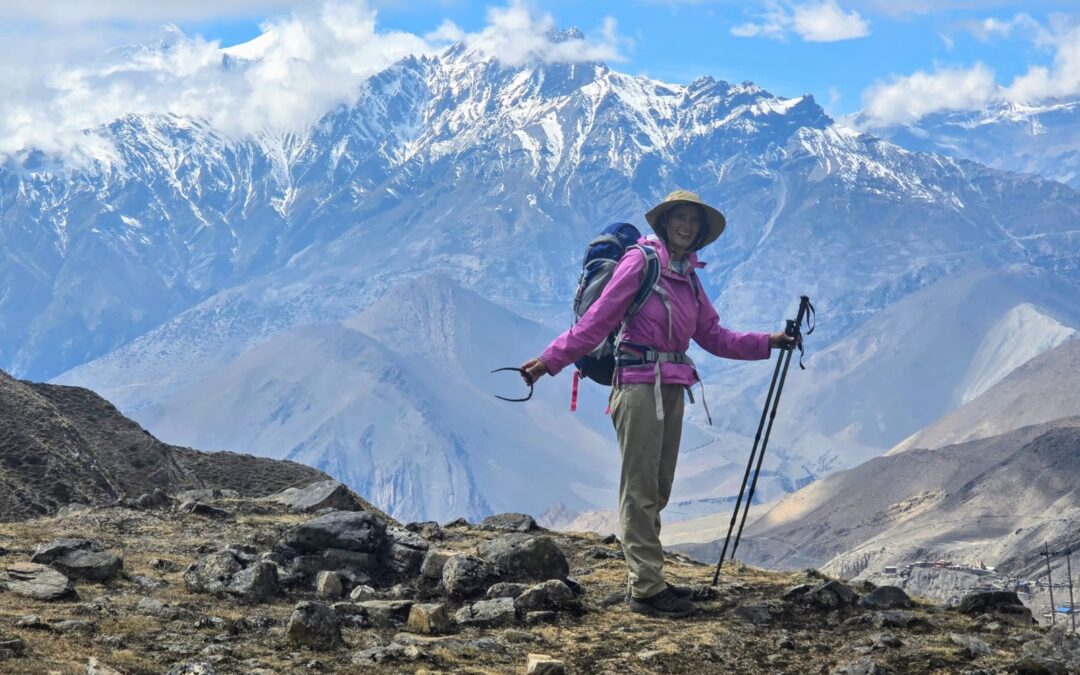
The mountain within: lessons on Pain, Fear & Survival from the Annapurna Circuit
We often think of pain as a simple mechanical failure—a worn-out hip or a strained disc. But as I found myself hobbling down from 5,400 meters on the Annapurna Circuit, I was reminded that pain is never just about the body. It is a story told by the nervous system, written in the language of survival.
When the Professional Becomes the Patient
I went to Nepal as a physiotherapist, a somatic experiencing practitioner, and a mindfulness teacher. I came back as a student of my own nervous system.
Early in the trek, a simple head cold began to unravel my resilience. At altitude, breath is life; when your breathing is compromised, your brain receives a primal signal: “Not safe.” This subtle shift in my internal state set the stage for what followed—a cascade of physical symptoms that mirrored my internal distress. As my hip tightened into tendonitis, my body did exactly what it was evolved to do: it protected me. I began to “brace,” using my lower back to compensate for the hip. In Pain Neuroscience, we know that when the brain perceives a threat (whether that’s altitude sickness, the fear of failure, or physical injury), it increases muscle tone to create a “splint.” My back wasn’t just “sore”; it was a fortress. This is the Freeze Response in action—a state of high sympathetic arousal where the body tightens to withstand an impending blow.
The Competition vs. The Connection
I noticed a familiar, conditioned pattern: the drive to keep up, to compete with my husband, to prove I was “fine.” This cognitive “pushing” effectively muted my body’s softer signals for rest. In Somatic Experiencing, we look at how we override our biological boundaries as well as our underlying emotions. This ‘overriding’ often starts when we are growing up and our neural networks are starting to form. By ignoring the initial hip tightness to maintain a certain pace, I forced my nervous system to speak louder. It eventually moved from a whisper (tightness) to a scream (sciatica).
The Turning Point: Finding Safety
The most significant shift didn’t come from a stretch or a pill. It came from “Emotional Awareness and Expression Therapy” and communication for help – thereby activating my “soothe” part of my nervous system – the cornerstone of safety. (If we think of how babies find safety – they cry out for help). In the polyvagal theory, we can say this is the ventral vagal brake being activated.Vulnerability: I stopped pretending. I spent some time tracking my body somatically and curiously exploring what the back bracing was protecting me from. In pain science we always say that “pain is protective”. I spoke to my back as if it were a little innocent child and enquired what it was afraid of. The answer made me cry! This little innocent part was worried that if I didn’t push through, achieve and be perfect at this summit, I would lose my connection with my husband. He would reject me. Now, I knew that this was completely illogical as my husband and I have been together for many years and I knew that we would survive this, even if we did not complete the summit, so I assumed this fear was coming from a much younger part of me. I know this part – it’s the perfectionist, overachiever 13 year old part of me!! The part that learnt that these traits bring connection. I gently worked with this part, thanked it for its concern and showed it how old I was and that I, the wise 49 year old adult, was going to keep us safe and loved. I then told my husband and my guide exactly how afraid and in pain I was and we made a new plan. By having the guide carry my pack and slowing our ascent by an extra day to acclimatise, my environment became “safe” again. Once I felt heard and supported, my nervous system could move out of the “Freeze” state. The bracing began to soften, not because the disc was “fixed” instantly, but because the perceived threat had diminished.
Now back at sea level, I am sitting with my residual sciatica and my reflections. My recovery isn’t just about physical therapy; it’s about Down-regulation. It’s about allowing the inflammatory markers to settle and reminding my nervous system that the mountain has been crossed.We cannot outrun our biology. Whether you are on a mountain or in the stresses of daily life, your pain is a messenger. The question is: are you creating a safe enough environment to listen to what it’s saying?